



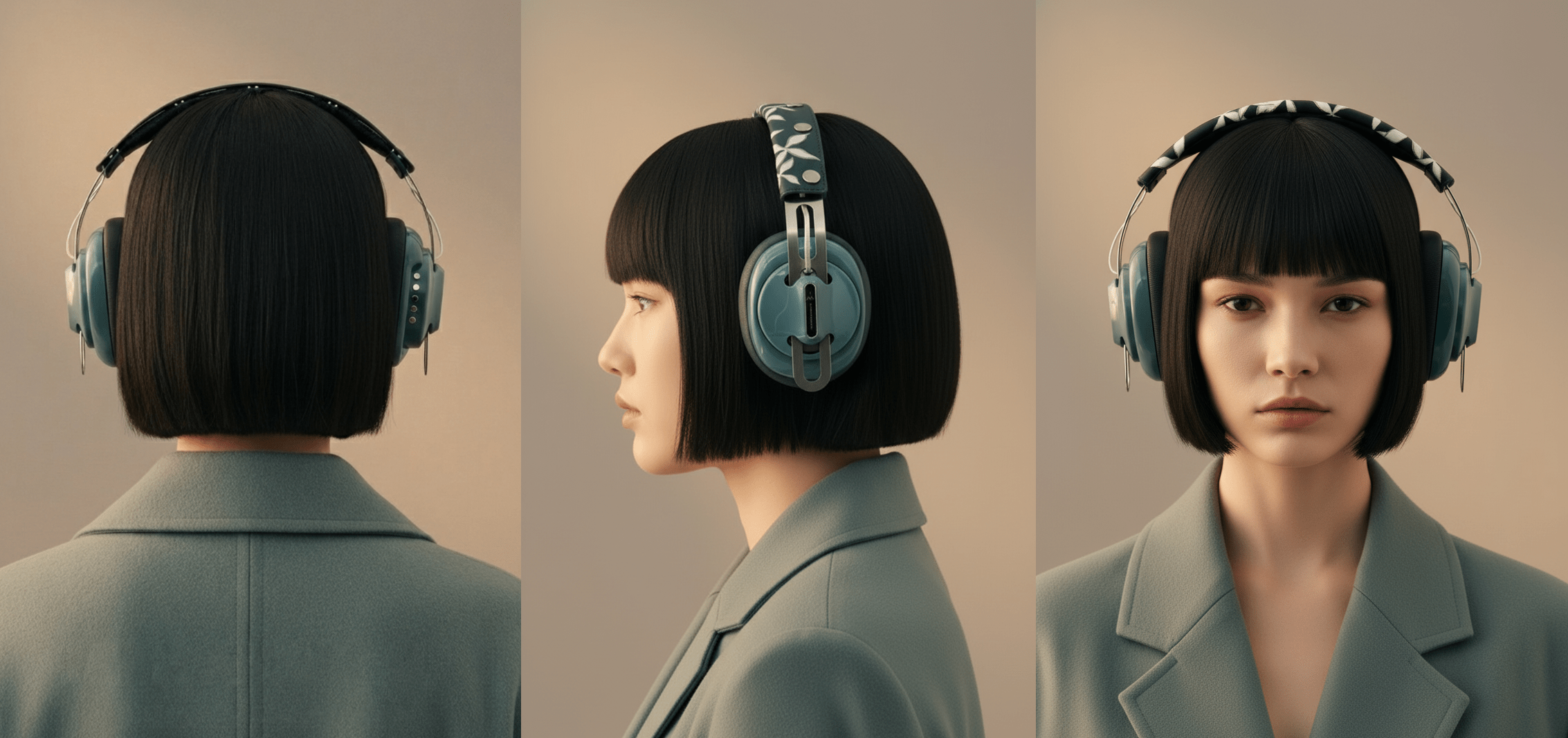
Choosing between over-ear and on-ear headphones sounds like a minor detail — until you put both on and realize they feel nothing alike. One wraps entirely around your ears, creating a sealed sound environment. The other rests lightly on the outer ear, keeping you tuned in to your surroundings. Same category, very different experience.
For most buyers, the decision comes down to three factors: comfort over long sessions, how much noise isolation you want, and portability. But there is a fourth consideration that rarely appears in spec sheets: the aesthetic. Over-ear headphones have a larger visual footprint — expressive and easy to style as an accessory. Understanding both types is the first step to choosing the pair that will stay in daily rotation.
What Are Over-Ear Headphones?
Over-ear headphones (circumaural) have earcups large enough to fully surround the outer ear. The cushioned ring sits against your head and cheek — not on the ear itself — creating a closed acoustic environment. This sealed space is the foundation of their sound isolation and typically richer bass response.
Because the earcup encloses the ear rather than pressing on it, over-ear headphones distribute pressure around the ear rather than directly on the cartilage. For extended listening sessions — hours of work, travel, or home audio — this tends to be significantly more comfortable.
What Are On-Ear Headphones?
On-ear headphones (supra-aural) have smaller earcups that rest directly on the outer ear. This design is inherently more compact and lightweight — they fold smaller, weigh less, and put less mass on your head. Whether the reduced isolation is a disadvantage depends entirely on context: in an office where you need to hear colleagues, or commuting where you need ambient awareness, on-ear can be the practical choice.

The earcup size and material define the listening experience. Over-ear cups fully enclose the ear; on-ear cups rest on the outer ear with a smaller footprint.
How Do They Work Differently?
Sound Isolation
Over-ear headphones create a passive seal around the ear — typically 15–25 dB of passive isolation even without active noise cancellation. On-ear headphones offer perhaps 5–10 dB of passive attenuation. If you are on a noisy flight or in an open office, over-ear wins decisively on isolation alone.
Comfort Over Time
On-ear headphones apply pressure directly to the outer ear cartilage. After 30–60 minutes, many listeners notice fatigue or soreness at contact points. Over-ear headphones distribute pressure around the ear — which is why they are the default choice for extended sessions. The Rainbow by MONIXIBI supports both configurations through swappable earcups.
Bass Response
The sealed environment of over-ear headphones allows low-frequency pressure to build more effectively. On-ear headphones, with gaps around the cushion, lose some bass energy to the environment. For full-spectrum audio reproduction, over-ear has a structural acoustic advantage.

The headband design is as important as the earcup — it determines clamping force, weight distribution, and — from behind — defines the visual silhouette.
Over-Ear vs On-Ear: Direct Comparison
| Feature | Over-Ear | On-Ear |
|---|---|---|
| Noise Isolation | High (15–25 dB) | Low–Moderate (5–10 dB) |
| Extended Comfort | Better — pressure around ear | Can fatigue ear cartilage |
| Bass Response | Fuller, more extended | Lighter, less sealed |
| Portability | Bulkier, heavier | More compact, lighter |
| Ambient Awareness | Low (good for focus) | Higher (good for safety) |
| Heat Buildup | More (enclosed ear) | Less (open sides) |
| Best Use Case | Home, travel, deep focus | Commute, office, gym |
Why Choose Over-Ear Headphones?
1. Superior Sound for Critical Listening
The enclosed environment supports fuller bass extension, a wider soundstage, and more precise stereo imaging. The Rainbow by MONIXIBI is built around a 40mm Hi-Fi driver with Qualcomm 3008 processing and LDAC/aptX Adaptive support — the over-ear configuration extracts the full performance of that hardware.
2. Comfort for Long Sessions
Hours of focused work, long-haul flights, or extended gaming sessions all favor over-ear. The pressure distribution around rather than on the ear makes sustained wear significantly more tolerable.
3. Modular Flexibility — Best of Both Worlds
The Rainbow's swappable earcup design means you are not locked into one wearing mode. Use the semi-over-ear pads for lighter commuting wear, swap to the full over-ear configuration for home listening. With over 96,000 configurations and accessories at 50% off for existing owners, one device adapts to every context.

Over-ear headphones have a visual presence worth choosing deliberately — the aesthetic and the acoustic commitment belong together.
What to Look For?
- Your primary listening environment — Working from home or traveling? Over-ear. Active commuter needing ambient awareness? On-ear may work better day-to-day.
- Session length — 3+ hours continuously? Over-ear comfort is worth the extra bulk.
- Audio priorities — Bass-heavy music, gaming, spatial audio all benefit from the sealed environment of over-ear.
- Heat sensitivity — Over-ear traps more heat. In warm environments or during exercise, on-ear is more breathable.
- Glasses wearers — The over-ear seal can be disrupted by temple arms. Look for deep, soft earcup cushions.
- Swappable configurations — If you cannot choose, find a headphone that offers both modes.
Frequently Asked Questions
Are over-ear headphones better than on-ear?
For sound quality and extended comfort, over-ear has a structural advantage. But "better" depends on use case — on-ear headphones are lighter, more portable, and maintain ambient awareness, making them a genuine preference for commuters and active users.
Do on-ear headphones hurt your ears?
On-ear headphones apply direct pressure to the outer ear cartilage. For sessions under 30–45 minutes, most people notice little discomfort. For longer sessions, the sustained pressure can cause soreness, particularly at the top of the ear.
Can I use over-ear headphones for exercise?
Over-ear can be used during light to moderate exercise, but the enclosed earcup traps heat and moisture. For running or high-intensity workouts, on-ear or in-ear designs are generally more practical.
Why do over-ear headphones sound better?
The sealed acoustic environment allows low-frequency sound waves to build pressure more effectively, translating to deeper bass. The enclosed space also reduces acoustic leakage, improving channel separation and stereo imaging.
Are modular headphones over-ear or on-ear?
Modular headphones like the Rainbow by MONIXIBI support both configurations through swappable earcups. You get both form factors from one device — semi-over-ear pads for commuting and full over-ear pads for deep listening at home.
Do over-ear headphones work with glasses?
Generally yes, but the temple arms can break the acoustic seal. The severity depends on cushion depth and softness — deeper, softer memory foam accommodates glasses frames better than thin, firm cushions.
How long do over-ear headphone pads last?
Standard synthetic leather earcup pads typically last 1–2 years with regular use before showing cracking or compression. Headphones with replaceable earcup systems — like the Rainbow, where earcups rotate off and snap on — eliminate this problem: swap pads when they wear out, not the whole headphone.
What is the difference between closed-back and open-back over-ear headphones?
Closed-back over-ear headphones have a solid outer shell that contains sound — strong noise isolation, minimal leakage. Open-back headphones have perforated cups that allow air and sound to pass freely, creating a more natural soundstage but with no isolation. Closed-back for public use; open-back for audiophile home listening.

The right headphone fits the moment — and the right modular headphone fits every moment.
One Headphone. Every Mode.
Semi-over-ear or full over-ear — swap between both. 40h battery, LDAC, 96,000+ combinations.
Explore Rainbow at monixibi.com

分享:
Stop Replacing. Start Swapping. Why Your Next Headphones Should Last a Decade
What Are Modular Headphones? The Complete Guide to Swappable Headphone Design